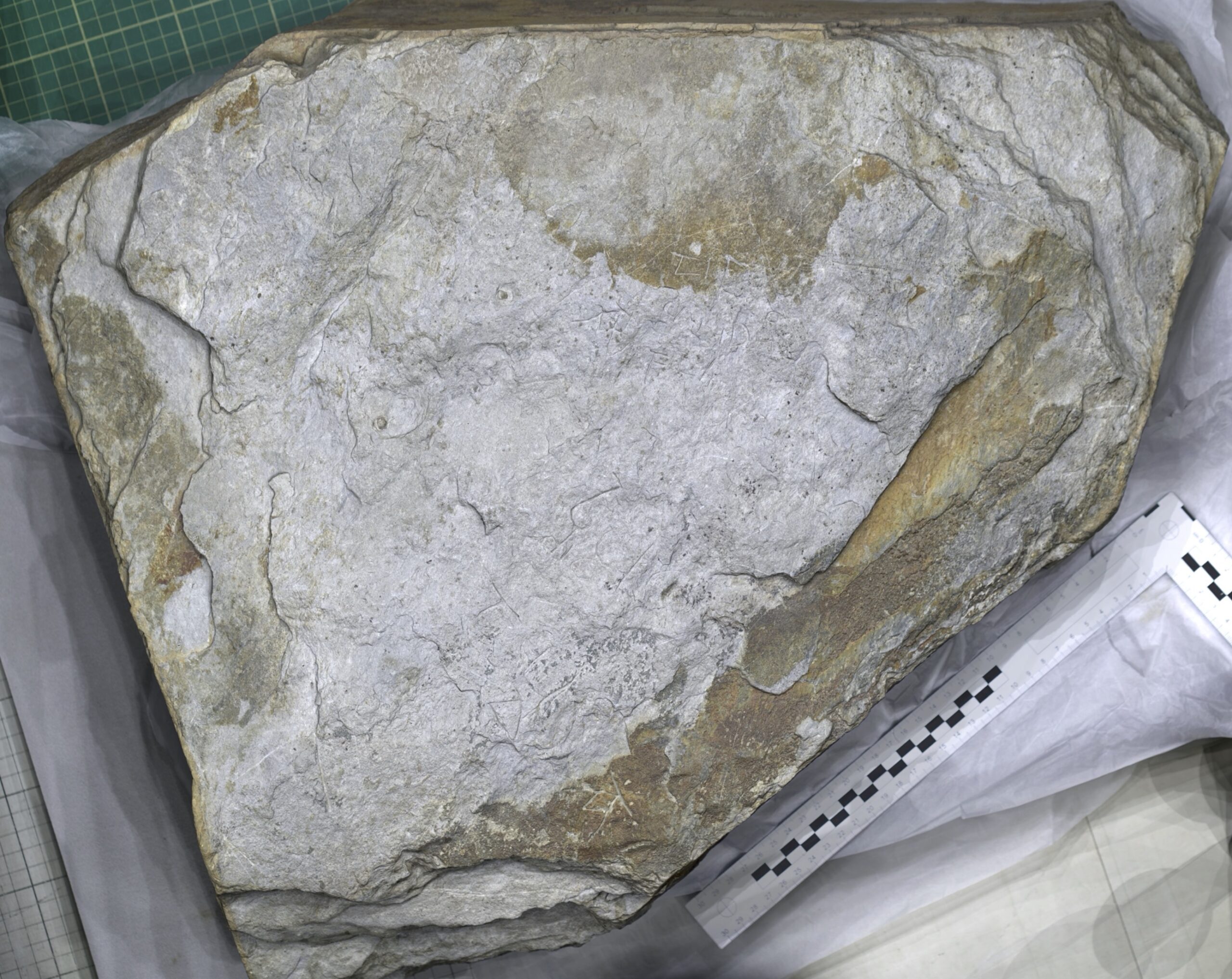
A faint inscribed slate from Tintagel needed more than straightforward photography. By using RTI to examine extremely shallow surface marks under changing light, I was able to clarify the organisation of the inscription and provide visual evidence that supported its interpretation within the Tintagel Castle Archaeological Research Project (TCARP) for Cornwall Archaeological Unit.
The subject
Tintagel is one of the key sites for understanding high-status life in post-Roman Cornwall. Among its early medieval buildings and imported material, this slate mattered because it offered direct evidence of writing. Found reused low down in a wall on the southern terrace, it preserves seven short lines scratched into the surface within a curved enclosing line. Rather than a formal public inscription, it is best understood as an experimental or casual piece of writing, closer to a trial piece than a monument.
The challenge
The inscription is difficult because the marks are light, uneven and easily confused with the natural texture of the slate. Some surface features can look like letters until they are tested carefully. This was not simply a matter of taking a better photograph. The real problem was how to separate deliberate incisions from geological lines, pockmarks and other irregularities on a rough stone surface.
That is why I selected RTI. It allowed the slate to be examined under changing light, making faint scratches easier to inspect and compare than they would be in a single fixed image. For lightly incised detail of this kind, it was the right technique.
What I did
I carried out the imaging work on behalf of Cornwall Archaeological Unit (CAU) for the Tintagel Castle Archaeological Research Project (TCARP). The slate was recorded using a fixed camera and a sequence of high-resolution images lit from different directions, then processed into an interactive RTI file for close analysis.
The key stage was analysis. I worked through the surface carefully to clarify which lines belonged to the inscription and which did not. The RTI showed the lettering clearly and also revealed other lines, both natural and deliberately made, that helped with the interpretation of the text.
I produced a report for the client which included annotated enhanced images of potential letters for the team’s consideration.
What became clearer
RTI helped confirm that this was not a random scatter of scratches. The inscription has a definite composition: seven short lines arranged in three groups within and around a curved frame. That structure matters because it shows intention, even within an informal piece of writing.
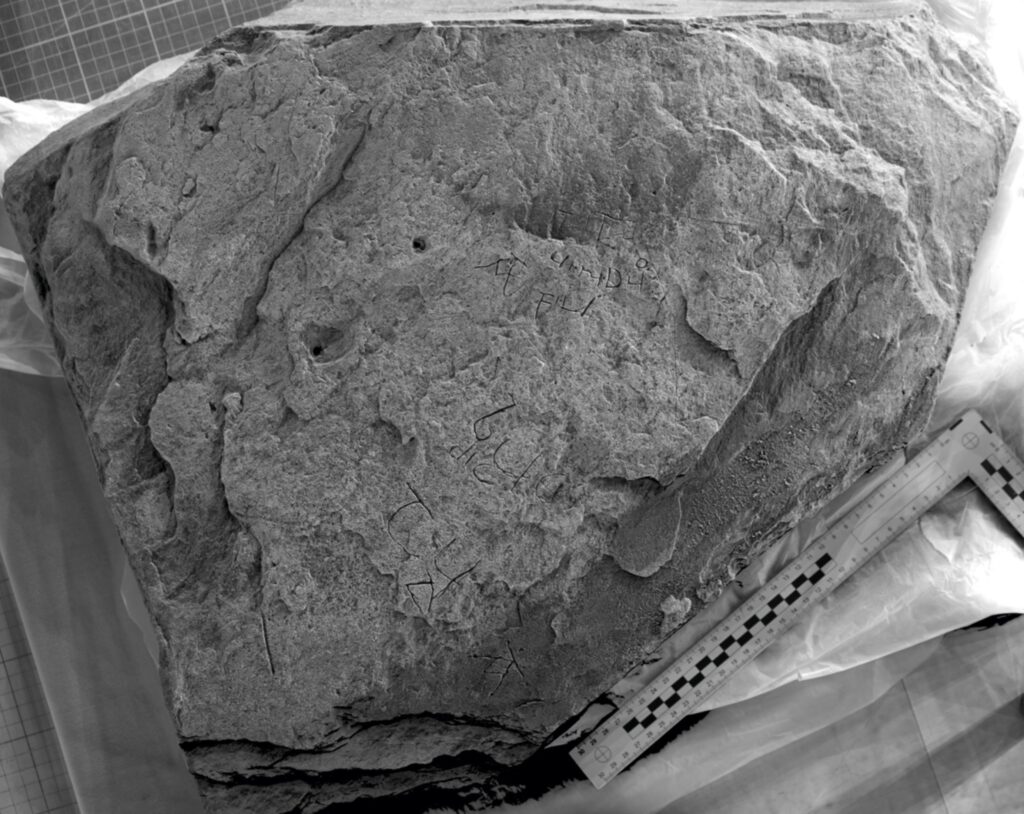
The inscription was then read and interpreted by Professor Michelle P. Brown and Dr Oliver Padel. Their work identified forms including TITO, UIRI DUO, FILI, BUDIC, TU and Δ A, and placed the stone within a wider context of manuscript culture, inscribed stone traditions and literate Christian practice. The closest parallels suggest a date around AD 650 to 700, while allowing a broader range either side.
Why it mattered
This project shows what digital imaging can contribute to a research team when the method fits the material. The value of the RTI was not simply that it produced better pictures. It helped turn a very difficult surface into usable evidence for interpretation.
At Tintagel, that meant supporting a clearer understanding of a rare piece of early medieval writing and helping place it within a broader picture of literacy, learning and Christian intellectual culture in post-Roman Cornwall.
If you are working with faint inscriptions, worn carved surfaces or difficult archaeological material, I can help choose and apply imaging methods that make the evidence clearer for research and interpretation.