
I used remote 3D surface enhancement to support Historic Environment Scotland and the Scotland’s Rock Art Project in investigating a remarkable group of prehistoric animal carvings hidden inside Dunchraigaig Cairn in Kilmartin Glen.
The subject
Dunchraigaig Cairn in Kilmartin Glen is an Early Bronze Age burial monument with an extraordinary hidden feature. On the underside of the slab covering one of its cists is a panel of carved animals, including two stags with branching antlers and at least two younger males. This matters because prehistoric rock art in Scotland is usually abstract. At Dunchraigaig, the imagery is unmistakably figurative, and the carvings have become recognised as the earliest known animal carvings in Scotland.
The challenge
This was a difficult surface to interpret. The carvings sit in a confined space beneath the capstone, and they are weathered, faint and unevenly preserved. Some details are hard to see at all in person, while others are easily confused with the natural texture of the stone.
The challenge was not simply to make the panel look clearer. It was to produce images that could help the team distinguish genuine carving from surface noise, understand how the animals had been made, and test the strength of the interpretation.
What I did
In 2021 I was commissioned by Historic Environment Scotland to support the Scotland’s Rock Art Project with enhanced imaging of the newly discovered panel. I worked remotely from structured light scan data captured by the HES Digital Documentation and Innovation Team using an Artec Leo scanner.
Using that 3D model, I produced a series of filtered renderings designed to bring out different aspects of the carvings. Some views clarified the anatomy and stance of the larger deer. Others helped make the fainter smaller animals more legible. Other renderings highlighted peckmarks and subtle changes in the surface, helping the team examine how the figures had been carved.
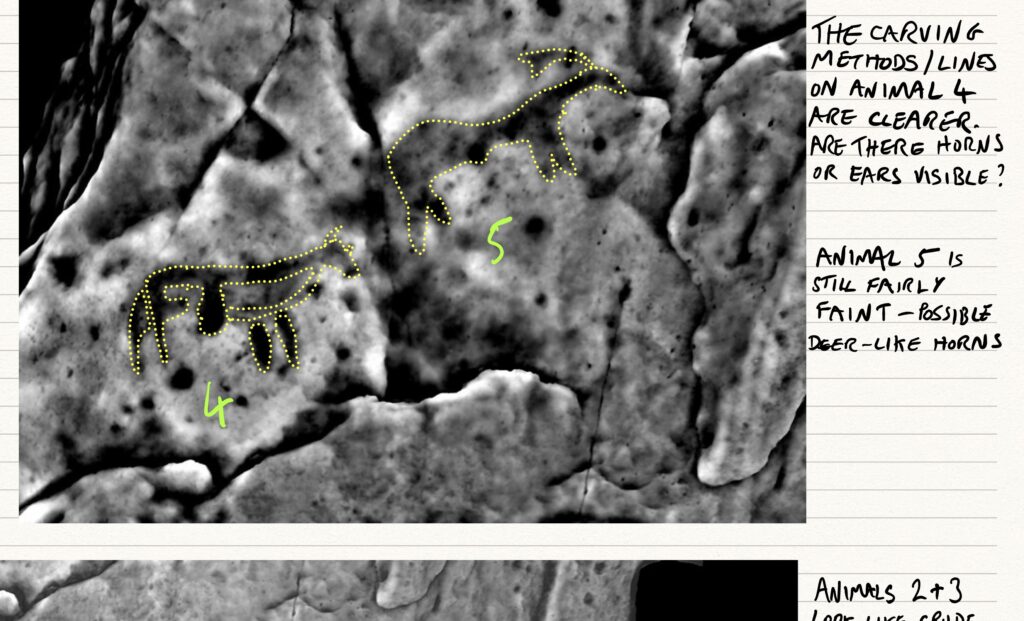
I used a ‘journaled’ approach, adding each enhanced image to an entry where I made notes and tracings of features to help explain my interpretation process to the team.
This kind of work depends on trying different ways of reading the same surface. There is rarely a single image that answers every question. The aim is to create a set of analytical views that help the archaeology come into focus.
What became clearer
The enhanced imagery helped support the identification of at least five animals on the panel. Two are clear stags with substantial antlers, while two smaller figures appear to be juvenile males. The largest animal, known as the Fabulous Stag, emerged as an especially powerful image, with a long neck, short tail, pronounced rump and large branching antlers.
The filtered views also helped bring out evidence of carving technique, including peckmarks, and made it easier to examine how the animals relate to one another on the stone. That mattered because the panel is not just a collection of marks. It is a carefully made group of figures with sequence, overlap and presence.
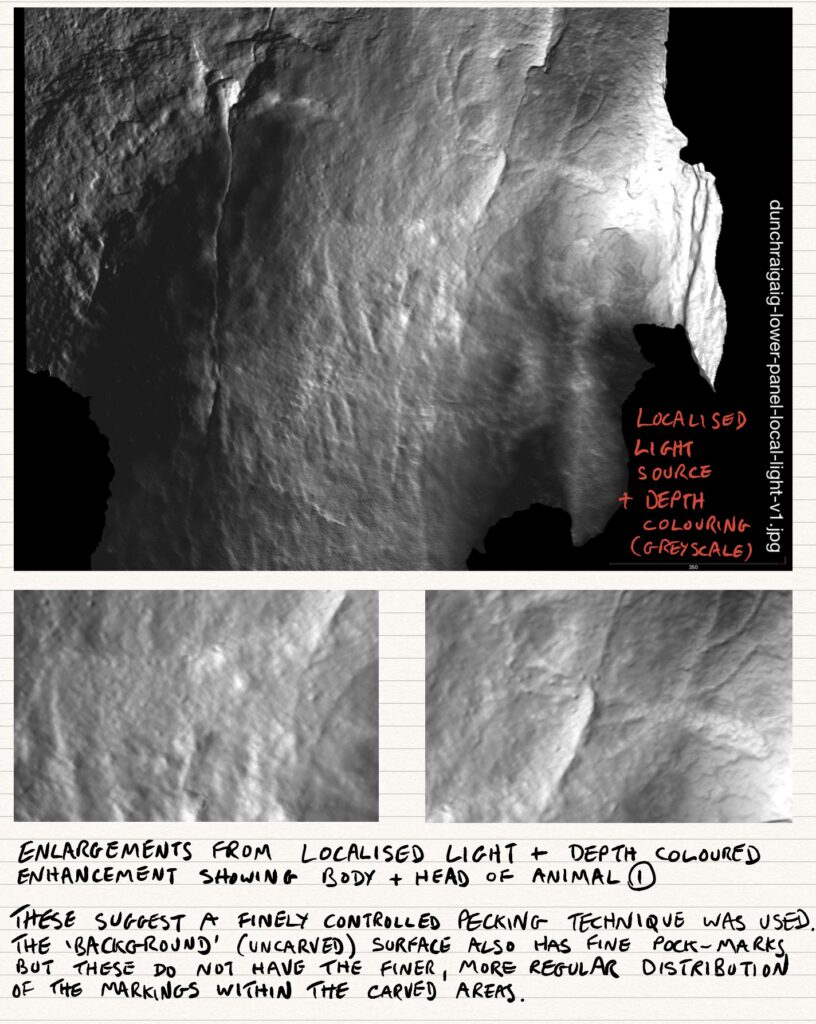
Just as importantly, the digital evidence helped strengthen the case for the carvings’ prehistoric date. The setting, the weathering and the position of the slab all support the conclusion that the animals appear to pre-date the completion of the cist, and may have been made on the slab before it was installed as the capstone.
Why it mattered
Dunchraigaig changes the picture of prehistoric rock art in Scotland. Instead of cups and rings alone, here is a hidden group of animals placed within a burial monument in one of Scotland’s most important prehistoric landscapes.
For me, the project is also a strong example of how digital surface enhancement can support interpretation at a distance. I never needed to be on site to make a useful contribution. Working from high-resolution scan data, I was able to help turn a difficult and subtle surface into clearer archaeological evidence. That made it easier for the team to interpret, test and publish one of the most significant rock art discoveries made in Scotland in recent years.
Read the full story in the team’s 2022 article Revealing the Earliest Animal Engravings in Scotland: The Dunchraigaig Deer, Kilmartin.
Need help making faint carvings clearer from new or existing 3D data? Get in touch to discuss surface enhancement, remote analysis and research support for rock art and carved stone projects.