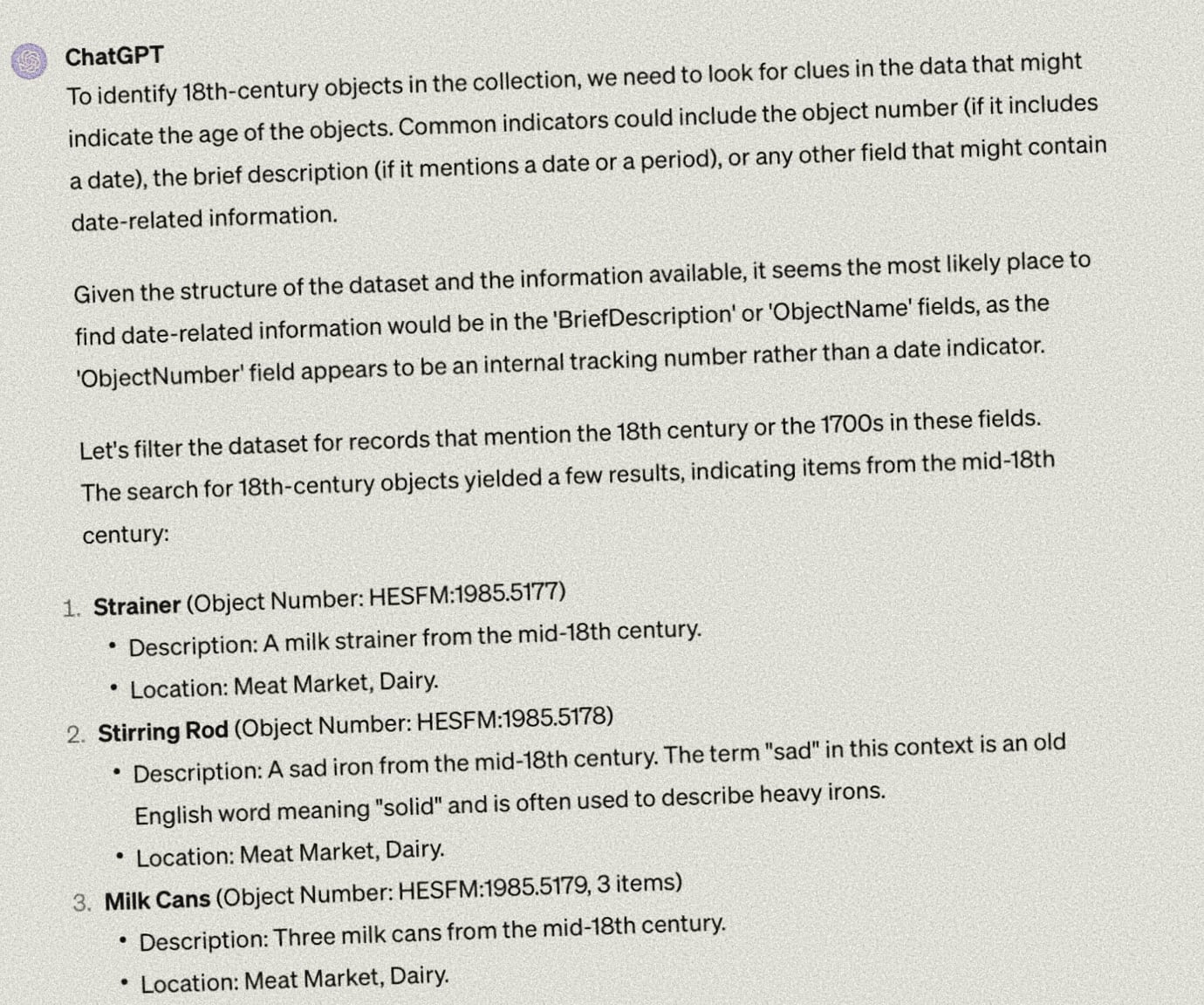
As part of a wider review of its dairy collection, the Museum of Cornish Life used conversational AI to test how its catalogue could be cleaned, explored and interpreted in new ways.
The subject
The Museum of Cornish Life holds an extensive collection relating to agriculture and rural industry in Cornwall. Among it is a substantial group of objects associated with dairying: tools, vessels, models, photographs and everyday working equipment.
As part of a broader review of this material, attention turned to the catalogue itself. Like many museum systems, it contains valuable information recorded over time, but often at inventory level, with brief descriptions and uneven terminology.
A subset of 129 records relating to “dairy” was exported from the MODES catalogue. This formed the basis for a focused test: not of the objects themselves, but of how well the catalogue can support enquiry, interpretation and future use.
The challenge
Museum catalogues are designed to record collections, not to be explored in open-ended ways.
This creates familiar constraints:
- Searching depends on knowing the right terms
- Descriptions are often too brief to support interpretation
- Data structures contain legacy fields and inconsistencies
- Relationships between objects are difficult to see
At the same time, the museum was actively reviewing its dairy collection. This raised practical questions:
- What does the catalogue actually allow us to understand?
- Where are the gaps or ambiguities?
- How easily can the collection be explored thematically?
The aim was not to replace the catalogue, but to look at it differently and test its limits.
What I did
I used ChatGPT as a controlled way to work directly with the exported dataset. The aim was to treat the catalogue as something that could be questioned, tested and reshaped, rather than simply searched.
Cleaning and clarifying the dataset
After uploading the CSV file, I first checked that the system correctly understood its structure. It identified the key fields and their meaning, confirming that the data had been ingested as expected .
From there, I prompted it to clean the dataset:
- removing empty or redundant columns
- renaming fields for clarity
- identifying missing values, including records without locations
This step exposed how the catalogue actually functions in practice, not just how it appears through its interface.
Exploring the collection through conversation
With a cleaned dataset, I began asking questions in natural language rather than using fixed search queries.
For example:
- “What objects relate to butter manufacturing?”
- “How many objects are located in the Meat Market?”
- “Can any of the objects be considered toys?”
The system responded by drawing together relevant records using related terms and associations. Objects such as stools, bowls, scales, butter stamps and churns could be grouped through their shared role in butter-making, even where terminology varied .
This shifted the catalogue from a static list into something that could be explored thematically.
Testing interpretation and context
I also asked the system to expand on individual objects. Where catalogue entries were brief, it combined the recorded data with general knowledge to suggest how an object might be understood.
This was handled cautiously. The outputs required verification, but they demonstrated how sparse records could be extended into more meaningful descriptions, especially if supported in future by institutional knowledge.
What became clearer
Working with the dataset in this way made several things visible.
The catalogue itself became more legible
Cleaning and querying exposed inconsistencies and gaps, such as missing location data and unclear fields. These are often hidden within day-to-day use of a collections system.
The collection could be seen in terms of activity
Conversational queries revealed groupings based on function and practice. Butter-making, for example, emerged as a network of related objects rather than a set of isolated entries.
Language proved critical
Vague prompts produced weak results, while precise questions generated useful answers. This reinforced that the system depends on both the quality of catalogue descriptions and the clarity of the questions asked.
The limits were also clear
The system could misinterpret queries or require adjustment, and all outputs needed to be checked. This was not an automated solution, but a guided process.
Why it mattered
This work formed part of the museum’s wider effort to review and understand its dairy collection. Within that context, the use of AI provided a new way of working with existing data.
It helped the museum to:
- Assess the quality of its catalogue by revealing gaps, inconsistencies and unclear fields
- Interrogate the collection more flexibly, without relying on rigid search structures
- Explore thematic connections between objects, supporting interpretation
- Identify where further documentation would add value
Just as importantly, it demonstrated a practical model for future development.
Rather than replacing collections systems, conversational AI can sit alongside them as a layer that makes data easier to question and interpret. It offers a way to move from searching for known objects to asking broader questions of a collection.
For a museum with its roots in everyday life and working history, this matters. The catalogue is not just a record. It is the foundation for how collections are understood, shared and re-used.
This experiment showed that even a modest dataset can become more useful, more revealing and more open to enquiry when approached in this way, provided that the results remain grounded in careful checking and curatorial knowledge.
A blog post on the wider project and these AI experiments with their catalogue is available on the Museum of Cornish Life website.
Interested in exploring how AI can help you understand, clean or reinterpret your collections data? Get in touch to discuss practical, research-led approaches tailored to your organisation.