Historic recordings often contain far more than first meets the ear.
A reel-to-reel tape, cassette, oral history interview or digitised disc recording may preserve voices, music, local accents, atmosphere and memory that cannot be recovered anywhere else. But those recordings are often difficult to use in their current state. Hiss, mains hum, clicks, crackle, distortion, uneven levels and other artefacts can obscure what matters most.
I help museums, archives, researchers and heritage organisations make historic recordings more listenable, more usable and easier to work with. That can mean careful digital restoration of an existing transfer, preparation of audio for access and interpretation, or combining restoration with AI-assisted transcription and summarisation to help collections become more searchable and useful.
The aim is not to make old recordings sound unnaturally modern. It is to reduce the distractions that get in the way, while preserving the character, texture and evidential value of the original source.
What this service helps with
Audio restoration is useful when a recording matters, but is hard to hear clearly enough to use with confidence.
That might include:
- oral history interviews with heavy hiss or background noise
- archive recordings affected by hum, crackle, clicks or intermittent interference
- quiet or muffled speech that needs careful enhancement
- music or performance recordings captured on domestic or semi-professional equipment
- recordings being prepared for exhibition, online access or gallery listening
- digitised audio that needs to be clearer before transcription or cataloguing
- heritage collections where the content is valuable, but the listening experience is a barrier
In many cases the problem is not that a recording is beyond use. It is that nobody has yet had the time or the right approach to help it speak more clearly.
Starting with digitised audio
I work with recordings that have already been digitised.
If you have tapes, discs or other analogue formats that have not yet been transferred, I can advise on suitable next steps, including where to go for digitisation or, in some cases, how to approach it yourself. Once a recording has been digitised to a good standard, I can work on the audio files to improve listenability, support access, and prepare them for uses such as research, interpretation or transcription.
A careful, heritage-led approach
Historic audio is not just content. It is evidence.
Every recording carries traces of the circumstances in which it was made: the room, the equipment, the background activity, the limitations of the medium, and the decisions of the original recordist. That is why restoration needs judgement.
My approach is usually light-touch and purpose-led. I identify the main issues affecting listenability, then make careful improvements without stripping away the warmth, texture and historical character of the recording. In some cases that means reducing tape hiss, suppressing mains hum, dealing with clicks and pops, or improving clarity in speech. In others it means stopping well before the recording begins to sound over-processed.
The question is always the same: what needs to become clearer, and why?
That answer changes depending on whether the recording is being prepared for research, public access, exhibition, broadcast, publication or transcription.
Seeing sound as well as hearing it
Part of this work involves critical listening. Part of it involves seeing the structure of a recording.
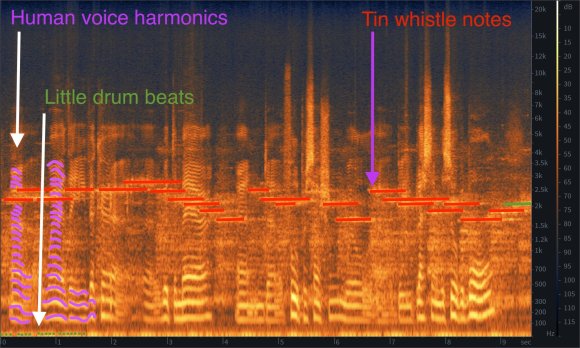
Spectrograms and other visual tools make it possible to inspect sound in detail, helping to identify persistent hums, bursts of interference, tonal noise, clipped events and other problems that can be difficult to isolate by ear alone. For heritage recordings with layered sounds, speech, music or environmental noise, this can be especially useful.
Used carefully, these methods help guide restoration decisions rather than automate them blindly. They are most powerful when combined with patient listening and an understanding of what is likely to matter in a historic recording.
AI where it is useful
AI can be genuinely useful in audio workflows, particularly when working with spoken-word collections such as oral histories.
Once a recording has been cleaned up enough to improve intelligibility, AI transcription can help produce draft transcripts, timestamps and summaries that make large audio collections more searchable and easier to catalogue. This is especially valuable for archives with many recordings and limited staff time.
I am interested in practical uses of AI that help unlock collections, not vague promises. In the heritage sector, that means combining restoration, transcription, prompting, checking and human review in a way that respects the complexity of real recordings, including regional accents, background noise, overlapping voices and historical vocabulary.
For some projects, this can make the difference between audio that is merely digitised and audio that is genuinely usable.
Types of material I can help with
I can advise on or work with a wide range of historic and heritage audio, including:
- oral history recordings
- interviews and community memory projects
- open reel and cassette transfers
- digitised disc recordings
- archival performance recordings
- private and family recordings with heritage value
- recordings for exhibitions and interpretation
- audio collections that need transcription or enhanced access
Where needed, I can also help think through how restored audio might be presented, interpreted or reused as part of a wider heritage project.
Examples of the kind of work I do
This work matters because it helps something become clearer.
That may mean making a speaker’s voice easier to follow, reducing noise so a transcript can be produced more accurately, preparing a recording for visitors to hear in a gallery or online, or helping a family, archive or researcher hear important details that were previously buried.
Recent work has included improving the listenability of a 1930s aluminium disc recording, where the challenge was to reduce the distraction of age-related noise while preserving the character of an unusual and fragile sound source. I have also worked on a late 1950s tape recording of a wedding, making it far more enjoyable to hear and bringing out details such as the vows, which had been buried beneath a wall of hiss and hum.
Earlier work has included the restoration of a 1967 reel-to-reel recording of an organ recital at Beverley Minster, where hum, hiss and other distractions could be reduced while keeping the warmth of the original performance. I have also explored how spectrogram-based analysis can help reveal the structure of complex archive recordings, including speech and music captured in challenging conditions.
Together, these projects show the breadth of what audio restoration can support: better listening, clearer interpretation, improved accessibility and, sometimes, the recovery of moments that would otherwise remain difficult to hear.
Who this is for
This service is particularly suited to:
- museums and archives with historic sound collections
- local studies and community heritage projects
- oral history programmes
- researchers working with spoken or performed audio
- organisations preparing recordings for public access
- private clients with historically important family or local recordings
- heritage teams who need practical help linking digitisation, restoration and interpretation
I work especially well where technical treatment needs to support a wider curatorial, archival or research aim.
Why work with me
I approach heritage recordings as cultural material, not just as audio files.
That means paying attention to what the recording is, how it may be used, and what needs to be preserved as well as what needs to be improved. My work sits between technical process and interpretative purpose. I am interested in helping collections become clearer, more accessible and more meaningful to the people working with them.
Where useful, I can also connect audio restoration to wider workflows around transcription, cataloguing, exhibitions, digital access and AI-assisted heritage research.
Get in touch
If you have historic recordings that are difficult to hear, or recordings you are planning to digitise and make more usable, I’d be glad to hear about them.
Whether you are working with oral histories, archive tapes, rare disc recordings or a larger heritage project, I can help you assess the next steps, from digitisation advice through to restoration, transcription and access.