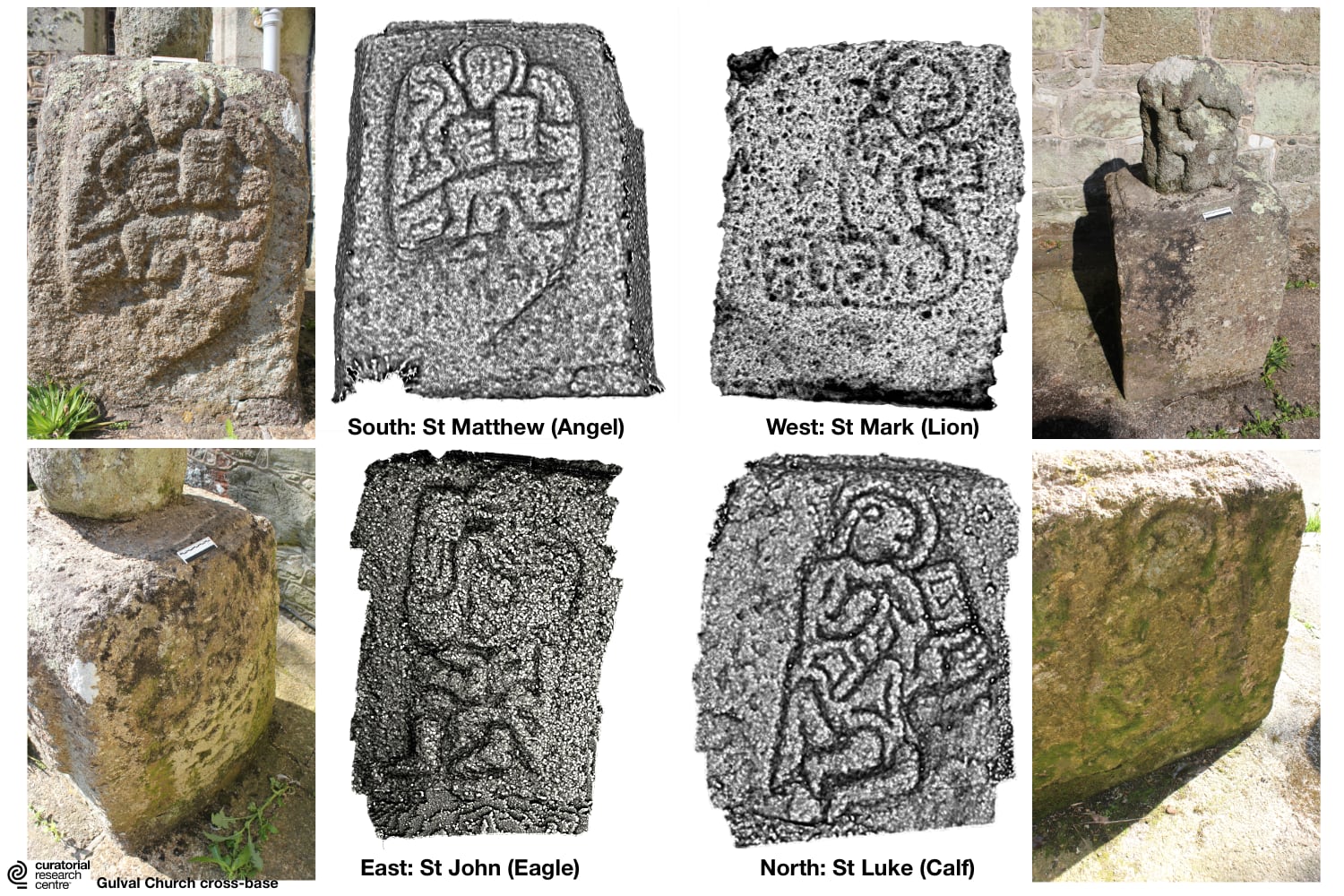
A worn granite cross-base next to the south porch at Gulval Church became newly legible through high-resolution 3D capture, helping identify its carvings as the Four Evangelists and opening up a wider story about early medieval Cornwall, Breton visual culture and the research value of digital surface analysis.
At Gulval Church, near Penzance, a substantial block of granite had been noticed for years as an old cross-base. It was clearly significant, but difficult to read. The carvings on its four sides were badly worn, visually confusing, and open to competing interpretations. Depending on the light and the viewer, they seemed to suggest a shield, an angel, David, the Virgin and Child, or other familiar early medieval subjects. The problem was not a lack of interest. It was that the imagery could not yet be seen clearly enough to sustain a convincing argument.
The subject
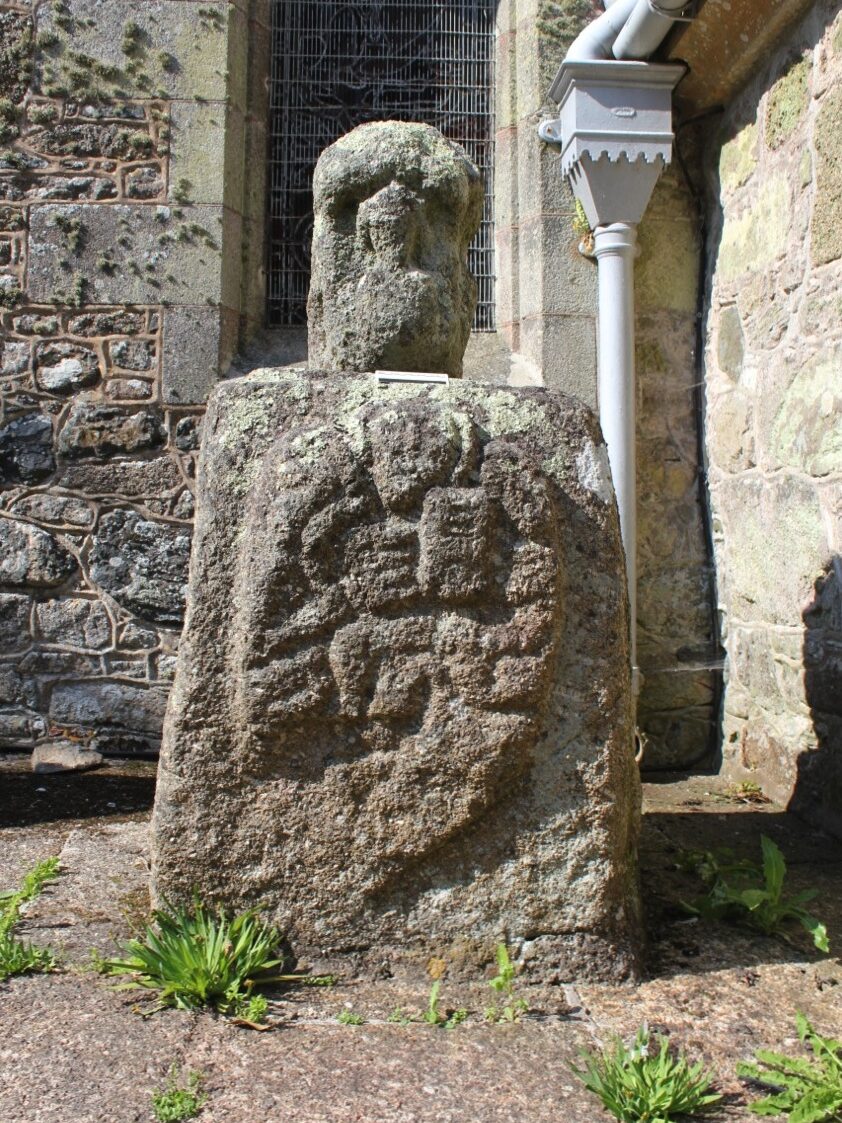
The monument is the base of a substantial medieval high cross, made from coarse Land’s End granite and re-used with a later lantern-cross head. It had attracted attention since at least the 1960s, and by 2012 was being looked at again by archaeologists and early medieval specialists who suspected that more survived on its faces than had previously been recognised. Even so, the carving remained frustratingly elusive. The stone mattered, but its imagery was still only half-visible.
That combination made it exactly the kind of object where digital recording could contribute something serious to research. This was not about producing a handsome model for display. It was about whether a difficult carved surface could be made more readable, and whether clearer visibility would change the interpretation. The answer, in this case, was yes.
The challenge
Gulval’s cross-base was hard to interpret because the stone itself fought back.
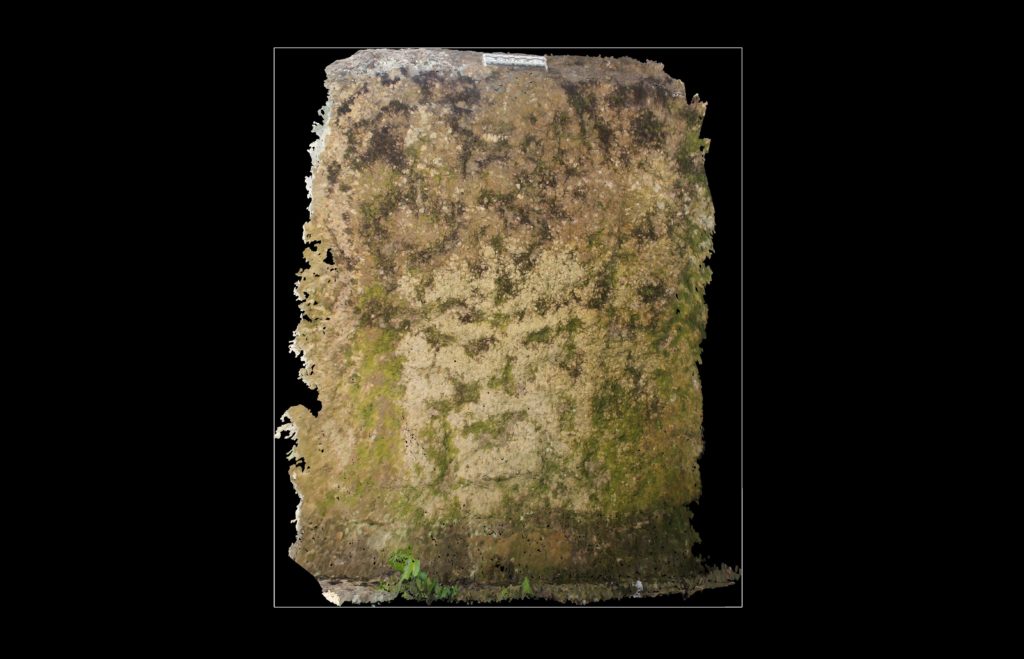
Coarse granite, with its reflective mica and uneven texture, can obscure carving as much as reveal it. Torchlight and raking light can be useful, but they also create strong shadows that hide one detail while sharpening another. Earlier photography had already shown that the monument was more complex than local tradition allowed, but photographs alone still left too much uncertainty. A fixed image under a single lighting condition was not enough to separate carved form from the visual noise of the stone.
That mattered because the research problem depended on secure identification. Until the carvings could be read with more confidence, it was difficult to place the monument in any wider historical, iconographic or regional context. The technical problem and the interpretative problem were therefore the same thing.
What I did
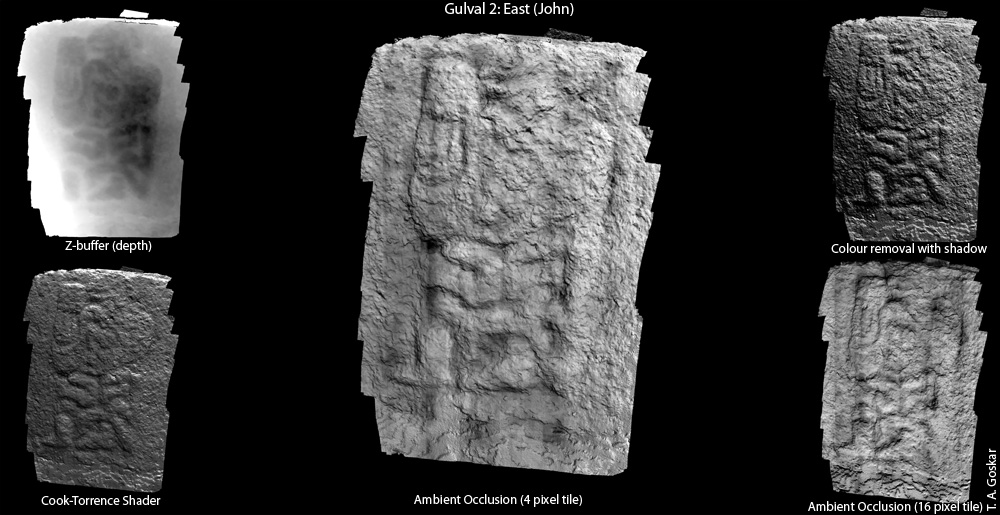
In 2012 I recorded the cross-base using high-resolution 3D photogrammetry, creating a dense digital model of the entire stone. The resulting point cloud and mesh were then analysed using enhancement techniques I had developed and used on rock art and inscriptions.
The key step was analytical rather than simply documentary. Once the surface had been captured as geometry, it became possible to remove the distracting colour information of the granite and examine the carving through filters that emphasised depth, curvature and accessibility across the surface. Ambient occlusion proved especially useful, because it brought out recesses and forms that ordinary photography struggled to separate from the grain of the stone. Faint details could be teased out of a literally grainy background.
The breakthrough came on the south face. After filtering the 3D data, the figure became suddenly legible as St Matthew, holding a book marked “MT”, with wings wrapping around the body in the shape that had earlier looked shield-like. Once Matthew emerged clearly, the logic of the whole monument shifted. The other figures could now be reconsidered not as disconnected possibilities, but as parts of a single iconographic scheme.
What became clearer
The carvings could now be identified as the Four Evangelists: Matthew, Mark, Luke and John. More specifically, they appear in a rare zoo-anthropomorphic form, with human bodies combined with the heads or attributes of their symbolic creatures. Mark kneels with the lion’s head, Luke appears with the calf, John with the eagle, and Matthew as the winged man. What had previously looked fragmentary and uncertain resolved into a coherent and highly unusual programme.
That was the point at which the research widened.
With the carvings identified, the monument could be considered alongside rare evangelist imagery associated particularly with Brittany and the scriptorium of Landévennec. In the later article, written with Professor Michelle P. Brown and published in British Archaeology, we were able to set the Gulval stone against the wider context of Breton Gospel books, especially the Bodmin Gospels, whose imagery and Cornish afterlife make them especially important for understanding early medieval Cornwall. The argument was not that Gulval simply copied one source, but that the clearer identification of the carvings allowed the monument to be placed within a much richer network of artistic, ecclesiastical and intellectual exchange.
That is where the balance of this project really sits. The digital work was not separate from the historical interpretation. It made that interpretation possible.
Why it mattered
The Gulval Evangelists are important because they show how digital recording can change the level at which a monument can be discussed.
Before the 3D work, the stone was intriguing but unstable. Afterwards, it could be treated as evidence. Once the evangelists became legible, the cross-base was no longer just a worn churchyard survival with interesting shapes on it. It became a monument that could speak to Cornwall’s place in the early medieval world, to links with Brittany, to the movement of Gospel imagery, and to the role of carved stone in expressing religious ideas in public space.
It also became a good example of collaborative research in practice. The discovery emerged from earlier observation and photography by others, from specialist early medieval scholarship, and from the way digital surface analysis could sharpen the evidence. Professor Michelle P. Brown’s contribution was crucial in extending the significance of the find beyond identification and into the larger world of manuscript culture, Cornish identity and transregional exchange.
The project then travelled further. As well as leading to the article in British Archaeology, the discovery also reached a wider audience through the Discovery website, BBC coverage, local newspapers, and the archaeological press. That broader attention mattered because it showed that a technically demanding piece of carved-stone analysis could also capture public imagination when the stakes were made clear: a familiar object in a Cornish churchyard had turned out to hold a much bigger story.
For me, that remains the value of this kind of work. 3D capture is most useful when it helps difficult material become historically usable, whether for archaeologists, historians, churches, museums or wider research teams. Gulval is a vivid example because the result was not just a better record of a monument. It was a clearer understanding of what the monument is, why it matters, and how Cornwall connects to a wider early medieval world.
Do you have a carved stone, inscription, or decorated surface that photography alone can’t resolve?
3D capture and digital surface analysis can reveal what the eye — and the torch — cannot.