Artificial intelligence can be genuinely useful in heritage work, but only when it is applied carefully, with a clear understanding of the material, the task, and the limits of the technology.
I help museums, archives, archaeologists and heritage organisations use AI in practical ways that support research, interpretation and access. This can include transcribing oral history recordings, summarising interviews and reports, improving the usability of collections or archive data, and helping teams make better use of their own documents and knowledge.
I also help to de-mystify AI. For some organisations, that means starting with the basics: what these tools are, how they work, when they are useful, when they are not, and how far their outputs can be trusted. For others, it means working through more advanced problems using real material such as catalogue exports, digitised documents, project records, or collections data. I can support this work remotely or in person, in one-to-one or group sessions, and help you identify a suitable AI provider such as ChatGPT, Claude, or Gemini.
I specialise in working with smaller organisations and teams, while also having experience across a wider range of heritage contexts, from charity-run museums and archives to local authorities and national bodies. In each case, the aim is the same: to find uses for AI that are realistic, proportionate, and genuinely helpful.
Where AI can help
Many heritage organisations hold large amounts of valuable but difficult material. This might include oral history recordings, archive sound, catalogues, legacy databases, object records, project reports, unpublished research, digitised books, and internal documentation. Even when digitised, these resources are often hard to search, compare, summarise, or interrogate in useful ways.
AI can help with tasks such as:
- transcribing oral history and archive audio
- summarising interviews, reports, and long documents
- extracting themes, keywords, and named entities from text
- cleaning and restructuring collections or museum data
- making internal knowledge easier to search and reuse
- supporting drafting, interpretation, and research workflows
These are not the most fashionable uses of AI, but they are often the most useful. A good workflow can save time, improve access, and make hidden or underused material much easier to work with.
My approach
I approach AI as an archaeologist and digital heritage specialist, not as a generic technology adviser. I work closely with organisations to help them use AI in ways that are practical, understandable, and relevant to their own material.
That means using plain language, encouraging questions, and working through examples together. I can help staff get started with prompting, show what AI can and cannot do, and test ideas using real material such as catalogue exports, digitised documents, reports, recordings, or other collections data. The aim is not simply to introduce a tool, but to help people use it with confidence and good judgement.
Heritage material is rarely neat. Audio can be noisy or incomplete. Catalogues are often inconsistent. Historical language shifts over time. Records contain ambiguity, bias, and gaps. In these contexts, AI is most useful as an aid to skilled human work, not a replacement for it.
My role is to help organisations work out where AI may genuinely help, where it needs close checking, and where conventional methods are still the better option. Good results depend on judgement, oversight, and a proper understanding of the source material.
Practical uses in museums and archives
In museums and archives, one of the most useful applications is transcription. Oral history recordings and archive audio can become far more accessible once they are turned into searchable text. That can support cataloguing, summarising, and long-term use, especially where collections include many hours of recordings and limited staff time.
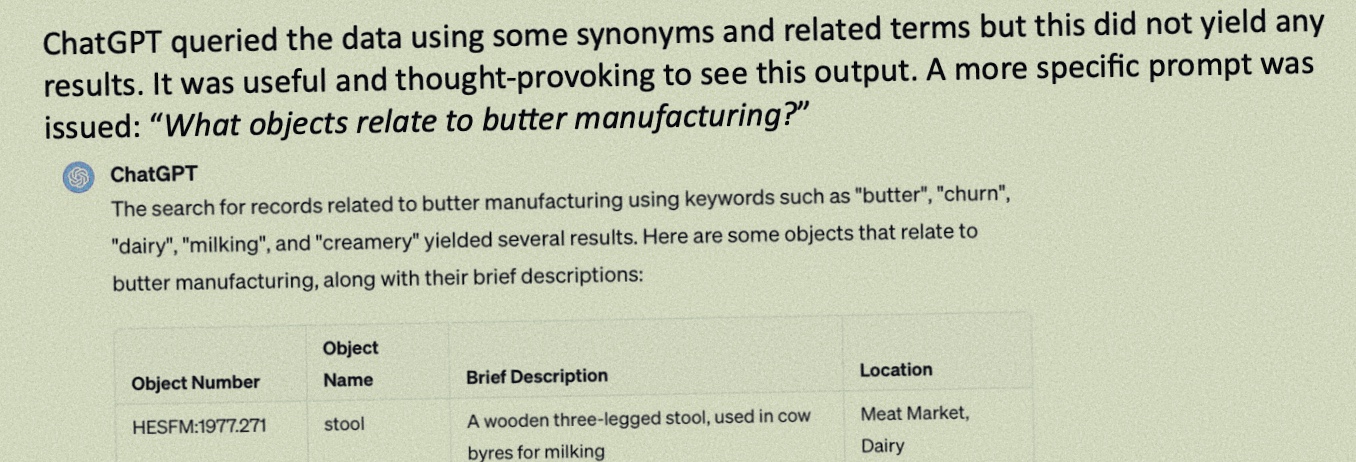
AI can also help with collections documentation. Museum data is often uneven, inconsistent, or difficult to search using conventional interfaces. With careful prompting and checking, AI can help clean exported datasets, identify gaps, and retrieve potentially relevant records through natural-language questions. It can also help staff and researchers explore collections in a more intuitive way, especially where terminology is inconsistent or specialist.
Another important use is working with internal knowledge. Heritage organisations often have decades of reports, notes, catalogues, research files, and policy documents scattered across folders and formats. AI can help make that material more searchable and more usable, whether for interpretation, collections work, exhibition planning, or research.
Qualifications and experience
My AI work is grounded in both formal study and practical experience. In early 2024 I completed Vanderbilt University’s Prompt Engineering Specialisation on Coursera, covering Prompt Engineering for ChatGPT, ChatGPT Advanced Data Analysis, and Trustworthy Generative AI.
I have worked with a wide range of heritage organisations, from small charity-run museums and archives to local authorities and national bodies. That breadth has made me a realist. Good digital and AI workflows have to fit the realities of an organisation, not just the possibilities of the technology.
My experience spans hands-on project delivery, supervising teams, and devising wider strategies. I have done the practical work myself as well as helping others structure and manage it. That means I can design systems and workflows from experience, not theory alone. I know where bottlenecks appear, where quality control matters, and where an apparently clever idea may not survive contact with the material or the day-to-day demands of the job.
Read about my commission by the Museum of Cornish Life to use AI to help them review their dairy collection.
What I can help with
Getting started with AI
Helping individuals and teams understand the basics, choose suitable tools, learn prompting, and build confidence in using AI responsibly.
OCR and handwriting recognition
Helping turn scanned documents into searchable, workable text. This can include printed documents, poor-quality scans, and handwritten material where the right AI tool can make a real difference. Some tools perform better than others depending on the character of the document, the style of handwriting, and the quality of the scan. I can help identify the most suitable approach, extract text in a usable form, and build workflows for checking, correcting, and using the results.
Audio transcription and text workflows
Setting up workflows for oral history, archive audio, interview transcription, summarising, indexing, and turning spoken material into something more searchable and usable.
AI for museum and archive data
Exploring practical uses of AI with catalogues, exported datasets, legacy records, project files, and other heritage documentation.
ChatGPT and generative AI for heritage teams
Helping staff use tools like ChatGPT more effectively for drafting, document analysis, research support, and internal knowledge work, while keeping accuracy, evidence, and critical judgement firmly in view.
Strategy and implementation
Helping organisations think through how AI fits into their wider work, from immediate practical tasks to longer-term planning, policy, and workflow design.
Why work with me
I have worked with a wide range of heritage organisations, from small charity-run museums and archives to local authorities and national bodies. That breadth has made me a realist. I understand that good digital and AI workflows have to fit the realities of an organisation, not just the possibilities of the technology.
My experience spans hands-on project delivery, supervising teams, and devising wider strategies. I have done the practical work myself as well as helping others structure and manage it. That means I can design systems and workflows from experience, not theory alone. I know where bottlenecks appear, where quality control matters, and where an apparently clever idea may not survive contact with the material or the day-to-day demands of the job.
Alongside formal qualifications and AI training, this practical experience is a large part of what I offer: approaches that are thoughtful, workable, and tested against the realities of heritage practice.
Get in touch
If you are exploring how AI might help with archive audio, collections information, research material, or internal knowledge, get in touch.
I can help you develop an approach that is practical, critical, and suited to the realities of heritage work.