
This project is now the case study Investigating and Recording the Chi-Rho in Cornwall.
Towards the end of 2024 I was asked to work on a project to investigate six medieval stones to ascertain whether or not they contained the Christian Chi-Rho symbol. The project came about following questions about the correct identification and terminology for the chi-rho on Cornish inscribed stones, and whether many of the descriptions on the Cornwall Historic Environment Record (HER) should be amended (as of 2026 this has now been completed, and all links are below). It was suggested to the HER that some of the symbols referred to as Chi Rho were in fact tau-rho and should be referred to as such in the official descriptions of the monuments in question.
Cornwall Council Historic Environment Record approached Anne Preston-Jones FSA and Andrew Langdon FSA to lead the project. I was asked to conduct high resolution photogrammetry to create detailed 3D surface models and then using my filtering and analysis techniques, produce imagery and evidence for the type of symbol used on each stone. It was great to work on this with Ann and Andrew, as we are all Fellows of the Society of Antiquaries.
The chi-rho monogram is an early Christian symbol combining the first two letters of the word “Christ” in Ancient Greek; the letters ‘chi’ (Χ) and ‘rho’ (Ρ). The tau-rho monogram, also known as the staurogram, is an equally ancient symbol combining the Greek letters ‘tau’ (T) and ‘rho’ (P), resembling Christ on the cross and symbolising His crucifixion and suffering. The chi-rho represents Christ’s name, and the tau-rho represents Christ’s crucifixion and suffering.
The project team visited and 3D scanned 6 ‘chi-rho’ stones in autumn/winter 2024:
- Sourton (West Devon)
- South Hill
- St Endellion Long Cross
- Phillack
- Madron
- St Just
Using photogrammetry as the recording method, a high resolution 3D surface was captured for each monument. These were then subjected to a series of digital analyses including depth mapping, ambient occlusion, along with my own technique, Smoothed Reference Surface Analysis (SRSA).
Some of my other experimental methods were also used. This included a ‘digital rubbing’ which uses an iPad Pro and stylus to apply contrasting digital colour at a set distance below a computed average smoothed plane fitted to the 3D mesh (based on SRSA). This deposits ‘ink’ only on areas that fall below this threshold, which can be adjusted in realtime using a multi-touch gesture. Although time-consuming to do, it acts like an inverted form of rubbing, and is useful for helping to identify very badly eroded details. This method also encourages slow interaction with the digital surfaces, allowing me to become very familiar with every detail on each monument (whilst using photographs on a separate screen for grounding interpretation).

The focus of this project was on the chi-rho and tau-rho symbols rather than the inscriptions, though the data can and will be used to further explore them. I performed the digital enhancements and provided imagery and opinions about my findings to Ann Preston-Jones and Andrew Langdon who studied them further and considered them within their wider research framework.
The Results: What we discovered
After the site visits, I processed the data from each monument. The high-resolution 3D surfaces, when filtered in different ways, allowed me to get up close with every groove and feldspar, revealing details that were either impossible to see with the naked eye or had been misinterpreted for a long time. Here’s what we found for each site, with links to the HER record which incorporates all of my imagery (except the Devon HER for Sourton):
Sourton Down Cross (West Devon)

When I first examined the 3D data from the Sourton Down Cross, it was immediately clear why people thought it had a tau-rho. However, my detailed analysis, particularly using depth mapping and SRSA, revealed a very different story. The so-called ‘symbol’ is actually a confusing jumble of shallow, unrelated grooves and scratches. They don’t form a coherent, deliberately carved shape. By using my ‘digital rubbing’ and depth mapping techniques, I could isolate these marks and see they were most likely caused by accidental damage over the stone’s long and complex life, perhaps during one of its various moves. Our conclusion was definitive: there is no early Christian monogram here.
View the updated Devon HER record.
South Hill

The South Hill stone was a fascinating puzzle. My 3D analysis confirmed the symbol is a tau-rho, not a chi-rho. What was really striking was how the depth mapping showed the tau-rho was carved much more lightly than the main inscription below it. This provides strong physical evidence that the symbol and the text were not created at the same time. The tau-rho appears almost like ancient graffiti, added in an earlier phase. This loosely supports the interesting theory proposed by others that this could be a mark left by the 6th-century St. Samson, with the memorial inscription added later to associate the deceased with the saint.
St Endellion Long Cross

The Long Cross at St Endellion is heavily weathered, making its details almost invisible to the naked eye. This is where high-resolution photogrammetry really shines. My 3D model revealed the symbol is a beautifully designed, sunken tau-rho, the most elaborate one we studied. The analysis also showed a clear misalignment between the symbol and the vertical inscription, which my Smoothed Reference Surface Analysis (SRSA) helped to clarify. This difference strongly suggests they were carved in two distinct phases. The 3D data was essential for verifying the shape of the rho hook and the decorative scroll beneath the cross, which were otherwise lost to erosion.
Phillack

The Phillack stone was the most difficult to record, as it’s built high into the gable of the church porch. Using a camera on a long pole, I managed to capture the data needed for a detailed 3D model. My analysis confirmed it is a true chi-rho—one of only a couple of genuine examples in Britain. However, the model also revealed something intriguing: the carving is incredibly sharp and clean. While this could mean it was well-protected, it also raises the possibility that it was ‘enhanced’ or re-cut during the church’s 19th-century restoration. My analysis can’t prove this either way, but it adds a layer of uncertainty to this nationally important monument.
Madron

The Madron stone was another case of mistaken identity. Initially thought to have a chi-rho, my analysis quickly showed this was incorrect. The symbol is actually a very unusual and ornate ‘flower-like’ cross. What became even more interesting was the inscription itself. By applying Ambient Occlusion and my digital rubbing technique, I could see significant differences in the depth, size, and style of the lettering across the stone. This wasn’t poor layout; it is potential evidence of the inscription being carved in multiple phases, possibly by different people. The 3D data has transformed our understanding of this stone from a single monument into a complex, multi-generational memorial.
St Just
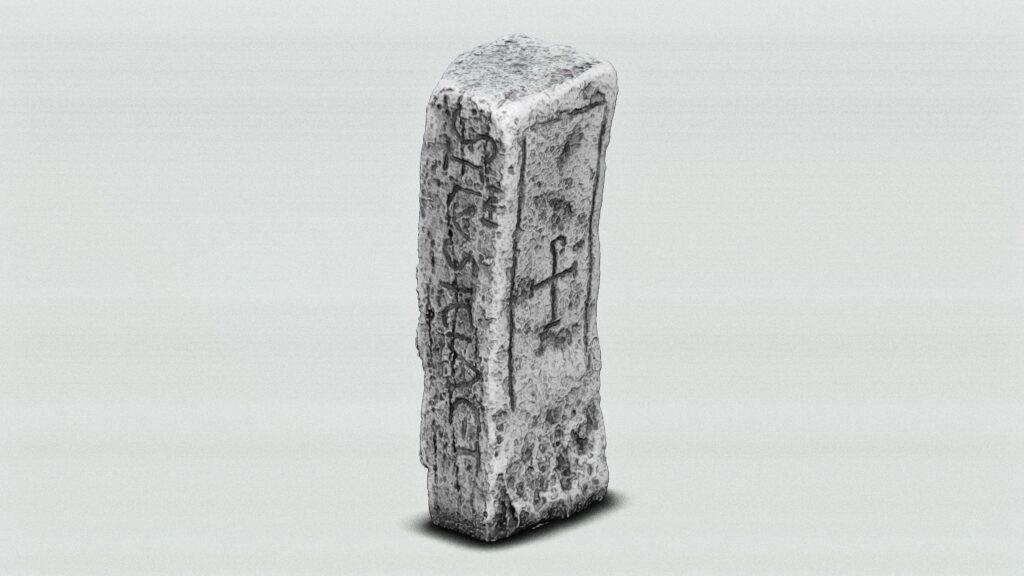
This stone, safely situated inside St Just church, was another great example of how 3D analysis can reveal the story of an object’s creation. My work confirmed the symbol is a tau-rho (no surprises here, but don’t always believe the chalk!). The key discovery came from examining the entire 3D model. The tau-rho is centrally placed within a frame on the stone’s main, wider face. The memorial inscription, however, is carved on the narrower side face. This separation strongly suggests a two-stage process: the Christian symbol was carved first, and the inscription identifying the deceased (‘Selus’) was added later. This gives us a fascinating insight into its function as an early Christian headstone.
This project is now the case study Investigating and Recording the Chi-Rho in Cornwall.